



Low-Frequency Ultrasound Selectively Kills Oral Cancer Cells Without Harming Healthy Tissue
Research Summary: Oral cancer cells are vulnerable to ultrasound-generated mechanical forces and undergo cell death. This non-invasive strategy also disrupts protective barriers of the tumor microenvironment, offering potential to enhance therapeutic efficacy.
Researcher Spotlight
Rashmita Luha is a PhD student in the Department of Bioengineering at the Indian Institute of Science, Bangalore. She works at Dr. Ajay Tijore’s “Mechanobiologics lab”. Her research focuses on developing a non-invasive, ultrasound-based treatment for oral cancer using low-frequency ultrasound.
Lab PI name: Dr Ajay Tijore, Indian Institute of Science, Bangalore
Lab website: https://tijorelab.com/ (Mechanobiologics lab)
What was the core problem you aimed to solve with this research?
The core problem was to explore a non-invasive alternative to the clinical ineffectiveness and severe side effects associated with conventional oral cancer therapies like chemotherapy and radiation. These traditional treatments often fail to selectively target cancer cells, leading to the destruction of healthy tissue and a significantly compromised quality of life for patients. This issue is particularly urgent in India, which bears over one-third of the global oral cancer burden.
How did you go about solving this problem?
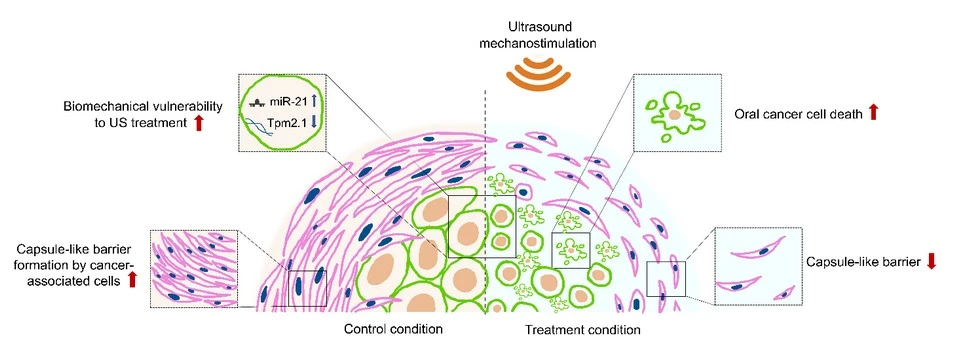
Since ultrasound is non-invasive and has been approved for various medical uses, we explored the effects of low-frequency ultrasound (LFU) on patient-derived oral cancer cells. We optimized the LFU parameters to achieve negligible thermal generation and induction of maximum cell death in cancer cells without harming normal cells. We developed a specialized 3D elastomeric coculture platform to mimic the complex tumor microenvironment. We used live-cell imaging along with ultrasound treatment to study the effect of LFU on interactions between cancer cells and the protective barrier formed by cancer-associated fibroblasts (CAFs).
“The novelty of this study lies in showing how ultrasound mechanostimulation can selectively target oral cancer cells by exploiting their mechanical weakness.” – Dr Ajay Tijore
How would you explain your research outcomes (Key findings) to the non-scientific community?
Oral cancer cells have a “physical glitch”: they lack a critical mechanosensitive protein called Tpm2.1, which makes them mechanically weaker than healthy cells. By applying specifically tuned mechanical forces using ultrasound, cancer cells undergo cell death—a process called mechanoptosis—while the surrounding healthy tissue remains unharmed due to optimal Tpm2.1 expression. In addition to cell death, ultrasound drastically reduces cancer cells’ ability to migrate and invade surrounding tissue, thereby reducing metastatic potential. Furthermore, the ultrasound treatment breaks down the protective capsule-like barrier that tumors build to shield themselves from the immune system and drugs.
What are the potential implications of your findings for the field and society?
These interesting findings could, in the future, improve ultrasound-based non-invasive cancer treatments. This study introduces a novel approach to selectively target cancer cells and the tumor microenvironment, potentially making existing drugs more effective by loosening the tumor’s physical barrier. This study holds significant potential for India, which accounts for over one-third of the global oral cancer burden. Since ultrasound is non-invasive and already approved for various medical uses, this strategy could eventually be used to enhance existing treatments for oral cancer and other accessible malignancies, such as breast or skin cancer, with minimal side effects.
What was the exciting moment during your research?
The most thrilling moment was seeing selective cell death (mechanoptosis) occur consistently across patient samples, regardless of cancer stage. Despite patients’ tumor heterogeneity, LFU triggers significant cell death without harming normal cells.
Paper reference: Luha R, Sankar G, Kumar A, Kumari A, Kulkarni K, Pratap R, Kapali A, Tijore A, Revealing biomechanical vulnerabilities in oral cancer cells using 3D coculture platform and low-frequency ultrasound, Materials Today Bio (2026).
https://www.sciencedirect.com/science/article/pii/S2590006426006204?via%3Dihub