



Super Nanozyme for Rapid MRSA Eradication and Wound Closure
Research Summary: We have developed a glucose-oxidase conjugated cerium-oxide nanozyme formulation that generates reactive oxygen species (ROS) at physiological pH in the presence of ATP, rapidly killing methicillin-resistant Staphylococcus aureus (MRSA) and eliminating infections promoting wound healing without systemic toxicity.
Researcher Spotlight
Divya Mehta is a Senior Research Fellow at BRIC-National Institute of Animal Biotechnology (NIAB), Hyderabad, working on nanozymes, antimicrobial resistance, nanomedicine, and catalytic nanomaterials for biomedical applications.
Linkedin: https://www.linkedin.com/in/divya-mehta-011725150/
Instagram: https://www.instagram.com/_diva01_
Lab: Dr. Sanjay Singh (Scientist-F), BRIC-National Institute of Animal Biotechnology (NIAB)
What was the core problem you aimed to solve with this research?
The rapid emergence and spread of multidrug-resistant (MDR) pathogens, particularly MRSA, have significantly reduced the efficacy of conventional antibiotics, making it difficult or sometimes impossible to treat bacterial infections. The challenge is further exacerbated in wound infections, where biofilm formation protects pathogens from antimicrobial agents and host immune responses, leading to persistent infections and delayed wound healing. To address these limitations, we aimed to develop an alternative antibiotic-free antibacterial strategy capable of efficiently eradicating antibiotic-resistant bacteria and disrupting biofilms under physiological conditions. The goal was to achieve selective bacterial killing through catalytic ROS generation while minimizing damage to host tissue, thereby providing a safe and effective alternative strategy for the treatment of resistant wound infections.
How did you go about solving this problem?
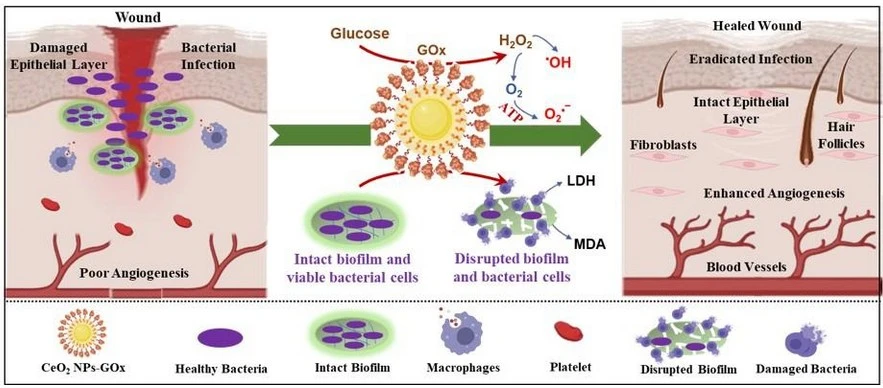
To address antibiotic-resistant wound infections, we engineered a hybrid nanozyme by conjugating glucose oxidase (GOx) onto cerium oxide nanoparticles (CeO2 NPs). We hypothesized that integrating GOx with the oxidase-mimetic CeO2 NPs would establish a self-sustaining catalytic cascade under physiological conditions. In the presence of glucose, GOx catalyzes its oxidation to generate gluconic acid and H2O2. These products subsequently serve as substrates for CeO2 NPs-mediated oxidase reactions, where the auto-decomposition of H2O2 generates O2 that continuously fuels the catalytic cycle. This reaction relay enables sustained production of ROS, particularly superoxide and hydroxyl radicals, resulting in potent antibacterial and antibiofilm activity. Under in vivo conditions, the resulting CeO2 NPs-GOx nanozyme effectively utilizes glucose and endogenous ATP present in the wound microenvironment to amplify ROS generation at physiological pH, enabling selective and efficient eradication of MRSA infection.
“Smart nanozymes – a next-generation weapon against antimicrobial resistance” – Dr. Sanjay Singh
How would you explain your research outcomes (Key findings) to the non-scientific community?
We developed a smart nanoparticle-based treatment that can effectively kill both drug-sensitive and drug-resistant disease-causing bacteria. In conditions such as diabetic foot ulcers and chronic wound infections, where antibiotic-resistant bacteria often make treatment extremely difficult, our approach offers a promising alternative, especially in situations where conventional antibiotics are no longer effective. Unlike traditional antibiotics, to which bacteria can gradually develop resistance, our treatment destroys bacteria by generating highly toxic reactive oxygen molecules that damage the bacterial cell membrane, making it difficult for the bacteria to survive or adapt. As a result, this strategy remains effective even against some of the most challenging drug-resistant infections. Importantly, reducing the dependence on antibiotics could also help slow down the emergence of new drug-resistant bacteria and decrease antibiotic contamination in the environment, benefiting both public health and the ecosystem.
What are the potential implications of your findings for the field and society?
This work offers a promising antibiotic-free strategy to combat antimicrobial resistance. The nanozyme could potentially be used for treating chronic wound infections, diabetic ulcers, and other antibiotic-resistant bacterial infections. It may help reduce antibiotic dependence and slow the spread of antimicrobial resistance worldwide.
What was the exciting moment during your research?
The most exciting moment was observing the complete eradication of MRSA infection and significantly accelerated wound closure in animal models within a short treatment period compared to commercially available antibiotics. Equally encouraging was the finding that the nanozyme exhibited excellent biocompatibility, effectively eliminating bacteria without causing damage to healthy host cells or inducing significant cytotoxicity. These results provided strong evidence that our nanozyme successfully progressed from a laboratory concept to a safe and highly effective therapeutic system for combating antibiotic-resistant infections.
Paper reference: Glucose-Oxidase Conjugated Cerium Oxidase-Based Super Nanozyme for Rapid MRSA Eradication and Wound Closure. https://doi.org/10.1002/adma.202520966