



New Strategy Targets Bacterial Master Regulator to Combat drug-Resistant Pneumonia
Research Summary: We identified the bacterial kinase StkP as a druggable target and showed that sorafenib weakens antibiotic-resistant pneumococci, reducing bacterial virulence and disease severity in preclinical infection models.
Researcher Spotlight
Joel Abraham is a post-graduate in Biomedical Engineering from IIT Bombay and is a senior research fellow in the host-pathogen laboratory at BRIC-Rajiv Gandhi Centre for Biotechnology, Trivandrum.
Linkedin https://www.linkedin.com/in/joelabraham916/
Lab: Dr Karthik Subramanian, BRIC-Rajiv Gandhi Centre for Biotechnology (RGCB), Trivandrum, Kerala
Lab social media: https://x.com/hostpatho_rgcb
Lab website: https://sites.google.com/view/hostpathorgcb/home
What was the core problem you aimed to solve with this research?
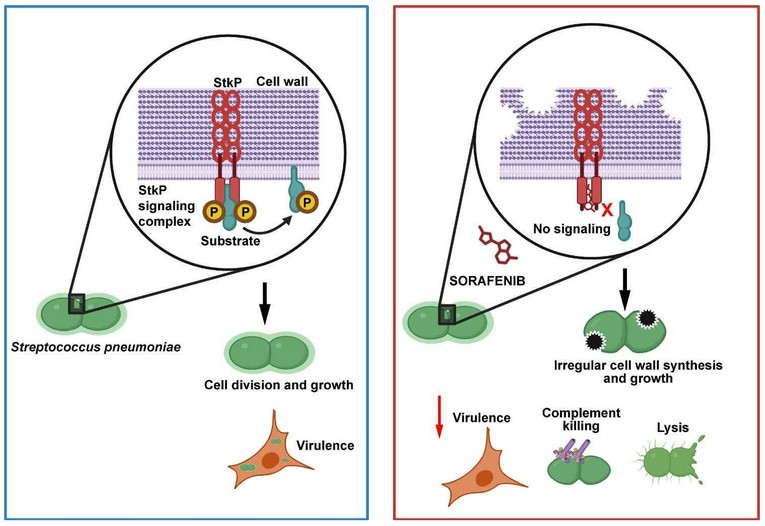
Antimicrobial resistance is making bacterial infections increasingly difficult to treat, including those caused by Streptococcus pneumoniae, a major cause of pneumonia, meningitis, and bloodstream infections worldwide. While most antibiotics target bacterial survival directly, resistance to these drugs continues to rise. We aimed to explore an alternative strategy by targeting a bacterial regulatory protein called StkP, a serine/threonine kinase that controls critical processes such as cell division, cell-wall synthesis, and disease-causing ability. Our goal was to determine whether disrupting this master regulator could weaken the pathogen and reduce its ability to cause infection.
How did you go about solving this problem?
We adopted a drug-repurposing approach, screening clinically relevant kinase inhibitors for their ability to inhibit pneumococcal StkP. Sorafenib, an FDA-approved anticancer drug, emerged as a promising candidate. We then combined computational simulations, bacterial growth and morphology studies, host-cell infection assays, resistance-development experiments, and a murine pneumonia model to evaluate whether sorafenib could inhibit StkP-mediated signaling and reduce pneumococcal disease progression. Additionally, on-target activity of sorafenib on StkP kinase domain was confirmed by protein based binding experiments and in vitro assays.
“By targeting a bacterial master regulator, we demonstrate how repurposed drugs can open new avenues to combat antimicrobial-resistant infections.” – Dr Karthik Subramanian
How would you explain your research outcomes (Key findings) to the non-scientific community?
Bacteria that cause pneumonia are becoming increasingly resistant to antibiotics, creating an urgent need for new treatment strategies. We discovered that sorafenib, a drug currently used to treat certain cancers, can weaken Streptococcus pneumoniae by interfering with a key bacterial control protein called StkP. This protein acts like a command centre that helps the bacterium grow, divide, and establish infection. When StkP is disrupted, the bacteria become less fit, less harmful, and easier for the body’s immune system to control. Importantly, treatment with sorafenib reduced disease severity in animal models of pneumonia, highlighting a potential new way to combat bacterial infections.
What are the potential implications of your findings for the field and society?
Our findings highlight bacterial kinases as an underexplored but highly promising class of antimicrobial targets. The study also supports drug repurposing as a faster route to identify new antimicrobial strategies. Since sorafenib is already clinically approved for cancer therapy, its antibacterial potential provides a useful starting point for developing improved derivatives or combination therapies. Scientifically, our study also validates bacterial kinases as a promising therapeutic target and opens new doors for developing therapies against bacterial pathogens. Such anti-virulence or host-pathogen-disarming strategies may help address antimicrobial resistance and improve treatment options for severe bacterial infections.
What was the exciting moment during your research?
The most exciting moment was when multiple independent lines of evidence converged on the same conclusion. We first observed that sorafenib inhibited StkP activity in biochemical assays, but seeing those molecular effects translate into reduced bacterial virulence and protection in an animal infection model was particularly rewarding. It transformed the project from an interesting laboratory observation into a compelling proof-of-concept for targeting bacterial kinases as a therapeutic strategy.
Paper reference: Abraham J, Sagilkumar A C, Dhyani H, Panchal C M, Aziz S, Priyadatha M K, Ruth A, Bhaskaran K, Chandrika S K, Shaima S, Varghese R, Neeravi A, Veeraragavan B, Narayanaswamy N, Ganesan S, Subramanian K. Sorafenib, a clinical kinase inhibitor, attenuates Streptococcus pneumoniae pathogenesis and reduces disease progression in vivo. mBio. E00618-26. https://doi.org/10.1128/mbio.00618-26
More from RCGB
m⁶A RNA Methylation Shapes Black Pepper Immunity
Decoding the epigenetic regulation of chromatin architecture in leukemia