



Protoporphyrin IX Prevents Pathogenic α-Synuclein Phase Separation in Parkinson’s Disease
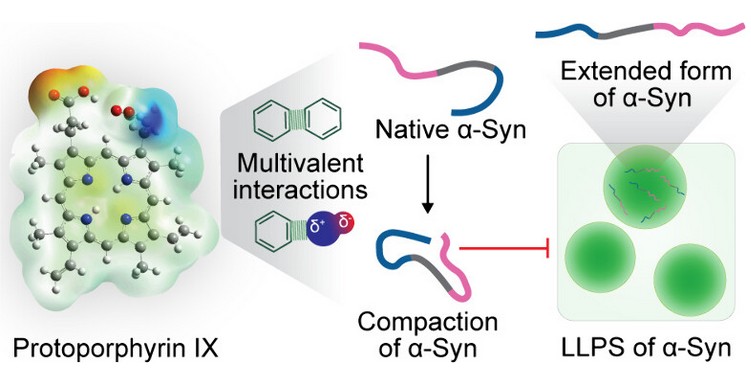
Research Summary: Protoporphyrin IX inhibits pathogenic α-Synuclein condensation by inducing a collapsed conformation of α-Synuclein. Multivalent interactions, particularly weak electrostatic forces, between α-Synuclein and Protoporphyrin IX collectively drive the underlying inhibition mechanism.
Researcher Spotlight
Souradip Paul is a graduate student in CSIR-IICB working with Dr Krishnananda Chattopadhyay. His research interests revolve around biomolecular condensates, macromolecular structures and conformations, and advanced microscopic and chemical biology tools.
Twitter: https://x.com/IndiaSouradip
BlueSky: https://bsky.app/profile/indiasouradip.bsky.social
Lab: Dr Krishnananda Chattopadhyay, CSIR- Indian Institute of Chemical Biology
What was the core problem you aimed to solve with this research?
At the heart of Parkinson’s disease pathology lies α-Synuclein, an intrinsically disordered protein, with a well-documented tendency to misfold and assemble into amyloid fibrils. Growing evidence has reshaped our understanding of how α-Synuclein forms fibrils, pointing to liquid-liquid phase separation (LLPS) as a critical driving force. In this process, α-Synuclein spontaneously partitions into a protein-dense condensed phase and a surrounding dilute phase, a behavior now recognized as a shared mechanistic feature among several neurodegeneration-linked proteins. During the early lag phase of α-Synuclein fibrillation, initial oligomerization gives rise to transient, liquid-like droplets. Over time, these droplets undergo a liquid-to-solid phase transition, maturing into amyloid fibrils. Crucially, the early oligomeric species populating this fibrillation landscape are now widely regarded as more toxic than the mature fibrils, making them a particularly important therapeutic target. In this study, we show that Protoporphyrin IX, an endogenous small molecule, arrests α-Synuclein LLPS at its early stages, thereby effectively disrupting the phase separation-driven fibrillation pathway of α-Synuclein.
How did you go about solving this problem?
To understand exactly how Protoporphyrin IX shuts down α-Synuclein droplet formation, we took a comprehensive approach by combining biophysical experiments, microscopic observations, and density functional theory calculations. Using ensemble and single-molecule fluorescence techniques alongside in-silico studies, we found that Protoporphyrin IX engages α-Synuclein through multivalent interactions. These interactions push α-Synuclein into a collapsed state that prevents it from undergoing phase separation. In addition, we used chemical biology tools to incorporate unnatural amino acids into α-Synuclein, which let us monitor its conformation in the presence of this molecule. We also wanted to understand which regions of α-Synuclein interact with Protoporphyrin IX. So, we systematically deleted different domains of α-Synuclein and measured the binding strength of each truncated variant to Protoporphyrin IX. We found that Protoporphyrin IX preferentially interacts with the N- and C-terminal regions of α-Synuclein which most likely triggers the conformational remodeling of α-Synuclein. Live-cell imaging confirmed that PPIX reduces intracellular α-Synuclein condensate formation, and in-cell fluorescence correlation spectroscopy revealed that PPIX preserves the dynamic state of α-Synuclein within cells. Collectively, this study establishes that PPIX inhibits α-Synuclein phase separation through multivalent interactions and conformational changes.
“We show that Protoporphyrin IX engages α-Synuclein through multiple weak interactions, limiting its conformational flexibility needed for phase seperation.” – Dr Krishnananda Chattopadhyay
How would you explain your research outcomes (Key findings) to the non-scientific community?
What if a molecule your own body already produces could intercept Parkinson’s disease before it takes hold? α-Synuclein is a protein found in brain cells that has no definite structure, constantly shifting between shapes like a molecular shape-shifter. Environmental stress or genetic mutations may trigger this protein to assemble into tiny liquid droplets that eventually harden into toxic clumps. These early droplets cause the most damage, as they can lead to tangling of other biomolecules in the brain. We found that Protoporphyrin IX, a naturally occurring molecule in the human body, grips α-Synuclein and forces it into a compact shape, rendering it incapable of forming these harmful droplets. This finding opens a promising therapeutic avenue against Parkinson’s disease.
What are the potential implications of your findings for the field and society?
Our findings carry significant implications for both the scientific community and the broader landscape of neurodegenerative disease. This work identifies a strategy to target α-Synuclein phase separation, a critical early step in its pathological aggregation. Also, due to physiological relevance of Protoporphyrin IX, it offers enhanced translational potential for Parkinson’s disease therapeutics compared to synthetic drugs. At a mechanistic level, this study advances a quantitative understanding of how small molecule-driven conformational transitions in an intrinsically disordered protein govern its phase separation propensity. Our work makes a significant contribution to the rapidly emerging field of condensate-modifying therapeutics.
What was the exciting moment during your research?
The most compelling moment in this study came when we tested a structurally related molecule sharing the same core architecture as Protoporphyrin IX but lacking its distinct molecular features, and found it considerably less effective at inhibiting α-Synuclein condensation. This comparison emphasized the potential role of dipole moments in directing small molecules toward intrinsically disordered proteins. We also found it noteworthy how Protoporphyrin IX drives conformational alteration of α-Synuclein, which subsequently regulates its condensation.
Paper reference: https://doi.org/10.1021/acs.jpclett.6c00339
Check BioPatrika Youtube channel here: https://www.youtube.com/channel/biopatrika